



Product Description
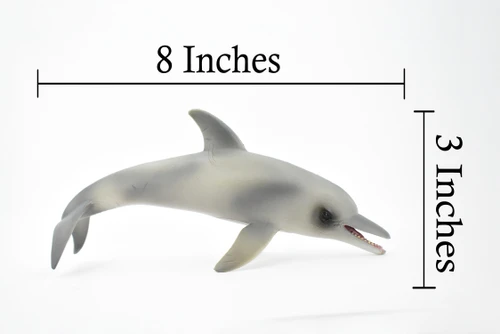
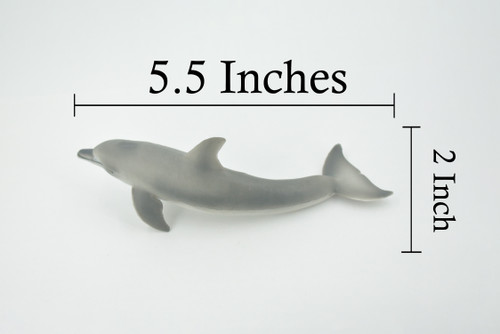
Dolphin, Spotted Dolphin, Porpoise, Marine Mammal, Museum Quality, Hand Painted, Realistic Toy Figure, Diorama Model, Educational, 8 Inches.
The coloring of the Atlantic spotted dolphin varies enormously as it grows, and is usually classified into age-dependent phases known as two-tone, speckled, mottled, and fused. Calves are a fairly uniform gray-white, with one or no spots. When they are weaned, speckling occurs, typically between 3 and 4 years and lasting for an average of 5 years. A juvenile is considered mottled when it develops merging gray and white spots on the dorsal surface and black spots on the ventral surface. This usually happens between age 8 or 9. A fused pattern is reached when dark and white spots are on both the ventral and dorsal sides. As the animal matures, the spots become denser and spread until the body appears black with white spots at full maturation. In comparison to other dolphin species, the Atlantic spotted dolphin is medium-sized. Newborn calves are about 35–43 in (89–109 cm) long, while adults can reach a length of 2.26 m (7 Ft. 5 in) and a weight of 140 kg (310 lb.) in males, and 2.29 m (7 Ft. 6 in) and 130 kg (290 lb.) in females. Compared to the much smaller pantropical spotted dolphin, the Atlantic spotted dolphin is more robust. It shares its habitat with the pantropical spotted dolphin and the bottlenose dolphin. The Atlantic spotted dolphin was first described by Cuvier in 1828. Considerable variation in the physical form of individuals occurs in the species, and specialists have long been uncertain as to the correct taxonomic classification. Currently, just one species is recognized, but a large, particularly spotty variant commonly found near Florida quite possibly may be classified as a formal subspecies or indeed a species in its own right. Atlantic spotted dolphins in the Bahamas have been observed mating with bottlenose dolphins. Rich LeDuc has published data that suggest the Atlantic spotted dolphin may be more closely related to the bottlenose dolphins (genus Tursiops) than to other members of the genus Stenella. More recent studies in the 2020's indicate that this is a consequence of reticulate evolution (such as past hybridization between Stenella (spotted dolphins) and ancestral Tursiops (bottlenose dolphins)) and incomplete lineage sorting, and thus support T. truncatus and T. aduncus belonging to the same genus. This likely explains why Atlantic spotted dolphins can mate with both species of bottlenose dolphins.
At Collectible Wildlife Gifts, we cater to a diverse clientele, encompassing families, friends, and educators. Our offerings have garnered the trust of professional organizations, including aquariums, zoos, and movie studios, who rely on our quality and educational value.
Our extensive product line features a variety of items, ranging from plush sharks to educational resources showcasing animal growth cycles. Each product is designed not only to bring joy but also to serve as an effective tool for learning. Whether you’re looking to inspire curiosity in a child or enhance an educational curriculum, our products spark interest and foster a love for the natural world.
We believe that learning should be an adventure, and our gifts make exploring nature fun and engaging. With every item, we aim to create memorable experiences that encourage conversations about wildlife and conservation. Our plush toys provide comfort while igniting the imagination, and our educational materials promote understanding and appreciation for various species.
Join us in celebrating the wonders of nature. Whether you’re shopping for a special occasion or seeking educational resources for a classroom, Collectible Wildlife Gifts has something for everyone. Explore our collection today and discover the perfect gift that will delight recipients of all ages while nurturing their love for wildlife and learning. Let us help you make a meaningful impact with gifts that inspire and educate.